
By John Helmer, Moscow
@bears_with
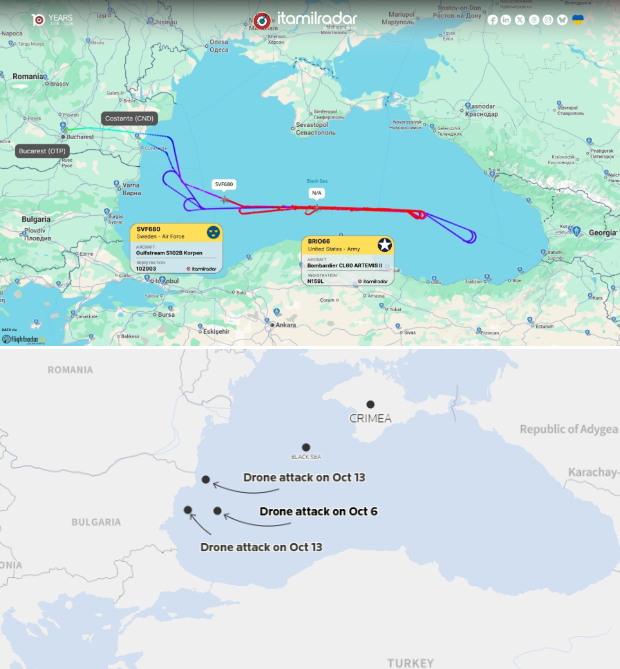
For three consecutive days last week, October 5-7, specially equipped intelligence-gathering aircraft of the Swedish Air Force and the US Army flew multiple missions over the southern area of the Black Sea, taking off from bases in Bucharest and Constanta, Romania, and concentrating on the Bulgarian coastline and territorial waters to the east; the northern Turkish coast; and Georgia (lead image, top map).
The Italian military monitoring site, Itamilradar.com, reported the flights as a big change in NATO operations in the region.
“What makes today’s activity particularly interesting is not the individual missions, but their overlap. The two aircraft are operating simultaneously over the same strategic area while approaching the mission from different basing arrangements and with different sensor configurations. This creates a more layered intelligence picture: the Korpen [Swedish Air Force] can contribute its specialized SIGINT collection, while ARTEMIS II [US Army] provides another US-operated source of electronic and communications intelligence. The combination is therefore more significant than simply counting two reconnaissance aircraft in the same area. The pattern also underlines the importance of Romania as an ISR [Intelligence, Surveillance, Reconnaisance] hub. Bucharest and Constanța allow allied aircraft to reach the Black Sea without requiring them to operate from distant bases, supporting a persistent surveillance presence over international waters.”
“Today’s simultaneous activity is another indication that Black Sea ISR is being conducted as a sustained NATO effort rather than as a series of isolated missions. After three consecutive days of Korpen operations, the Swedish contribution is particularly noteworthy, while the concurrent ARTEMIS II mission adds another layer to the picture.”
On October 6, two merchant vessels were hit in the Bulgarian economic zone of the Black Sea, the first strike at 70 nautical miles (nm — 130km) off the Bulgarian coastal town of Byala; the second 140nm east of the Bulgarian coastline (lead image, bottom map). Reuters reported: “Shipping sources said it appeared to be the first such attack in the waters of Bulgaria’s exclusive economic zone.” Blame was reported as Russian, and a Ukrainian denial of responsibility was printed.
The first vessel was independently identified as the Alfa Watan, Togo-flagged, Turkish-owned, which reportedly sank; the second was the Able, Palau-flagged, Turkish-owned, which subsequently made port at Varna. The Alfa Watan had been sailing north; the Able south.
Sea and aerial drones have been reported as the weapons used in the attacks. No recovery of drone fragments has been reported: if the Bulgarians and their NATO advisors have recovered evidence of the launch points and course, they are keeping it secret.
Bulgarian territorial waters extend eastwards into the Black Sea at a distance of 12nm; the exclusive economic zone (EEZ) extends from 12nm to 200nm. In the latter, Bulgaria has exclusive sovereign rights to explore, exploit, conserve, and manage natural resources (such as fish, oil, gas, and wind energy) in the water and seabed. However, the area of the attack is international waters for free navigation and flight.
Was NATO intelligence used by the drone operators to attack the two vessels? Was Russia responsible?
Maritime Executive, a maritime industry publication based in the US, reported: “Russia’s embassy in Bulgaria told Reuters that the two ships were not on the Ministry of Defense’s target list. It cautioned that an investigation was needed to identify the source of the drones that struck the two ships. The Maritime Administrator in Bulgaria, however, said the ship was outside the country’s direct responsibility and that they were not planning an underwater search. He did not comment on whether any debris from the drones had been recovered.”
A week later on October 13, there were two new drone attacks against vessels in the Bulgarian EEZ, just outside the territorial limit.
The Bulgarian press reported “Two merchant ships sailing in Bulgaria’s Black Sea exclusive economic zone on October 13 came under drone attacks, with one sunk, Prime Minister Roumen Radev said. The Turkish-owned, St Vincent and Grenadines-flagged Azov Concorde was hit 17 nautical miles from Krapets on Bulgaria’s north Black Sea coast and sank. One crew member was rescued. The Ukrainian-owned Maltese-flagged Chelsea 3 was hit 15 nautical miles from the coast of Byala, a small town about 50km south of Varna. Fifteen crew were rescued.”
The blame for the attacks on Russia was announced publicly by the Bulgarian government. According to Prime Minister Roumen Radev, “we do not have clear evidence to accuse any of the parties. But logic indicates that the result is in favour of the Russian Federation. Therefore, today I will call Ambassador Mitrofanova for a conversation.”
The Bulgarian and maritime media have not reported the NATO reconnaissance missions in the area at the time; the Italian military monitor was unaware of the drone attacks. The connection between them was discussed in this podcast with Nima Alkhorshid on October 13; click to view. In Moscow on October 14 there was an extended report on the incidents in Vzglyad, the Kremlin-backed platform for military, economic, political and security analysis.
The following is a verbatim translation into English without editing; illustrations have been added.
(more…)